The question
In NGC 253's starburst-driven galactic wind, do the hot-phase thermal pressures on the two sides of the disk match — at the 7–12 kpc scale, in matched full wedges about the minor axis
The estimand is a single number
RP = (ne × kT)SE / (ne × kT)NW
derived from matched-sector spectral fits of a new EPIC SE halo-offset pointing versus the archival NW pointing 0723220101. The comparison is reported as a 95% confidence interval on log10(RP). Three outcomes are preregistered: ASYMMETRY (CI excludes 1.0), SYMMETRY (CI includes 1.0 with σR < max-σR), and INCONCLUSIVE (σR ≥ max-σR
Why anyone should care
The default assumption in cosmological subgrid-feedback recipes is that a starburst-driven wind injects energy, momentum, and freshly-synthesized metals into the CGM symmetrically about the disk. The mass/energy loading factors (η) are written per-cone and assumed equal on both sides; CGM chemical-enrichment models assume the halo is enriched isotropically; and for any distant galaxy where the halo is unresolved and only one outflow side is seen, feedback is inferred from that single cone and assumed to apply to both
If a symmetric result is found in the nearest, best-resolved double-cone, that assumption is validated for the first time in a resolved system, and Bauer et al. (2008)'s measured SE-softer diffuse-X-ray contrast is consistent with the matched-aperture design eliminating the Bauer volume asymmetry (NW 298 kpc³ vs SE 113 kpc³). If an asymmetric result is found, the symmetric-injection default is refuted at the most basic level: single-cone feedback estimates are systematically biased, and the metal/energy budget escaping to the IGM vs recycling (fountain) differs per side
Cold molecular outflow is already known to be approximately symmetric S/N (Bolatto et al. 2013 ALMA CO(1-0) — T37, T68). A symmetric cold phase plus an asymmetric hot phase would be a clean multiphase-decoupling detection — hot wind and entrained cold gas shaped by different agents. A symmetric hot phase confirms multiphase coherence
Whose published conclusion changes Bauer et al. (2008, A&A 489, 1029) reported that the SE halo is softer than the NW halo in diffuse X-rays, but with unequal emitting volumes. I053 does not claim to overturn Bauer; it claims to test the matched, equal-volume thermal-pressure ratio that Bauer could not isolate, and to do so at a confidence level Bauer could not reach. The result either pins the symmetric-injection default or refutes it — both branches move the credence
What the measurement would look like
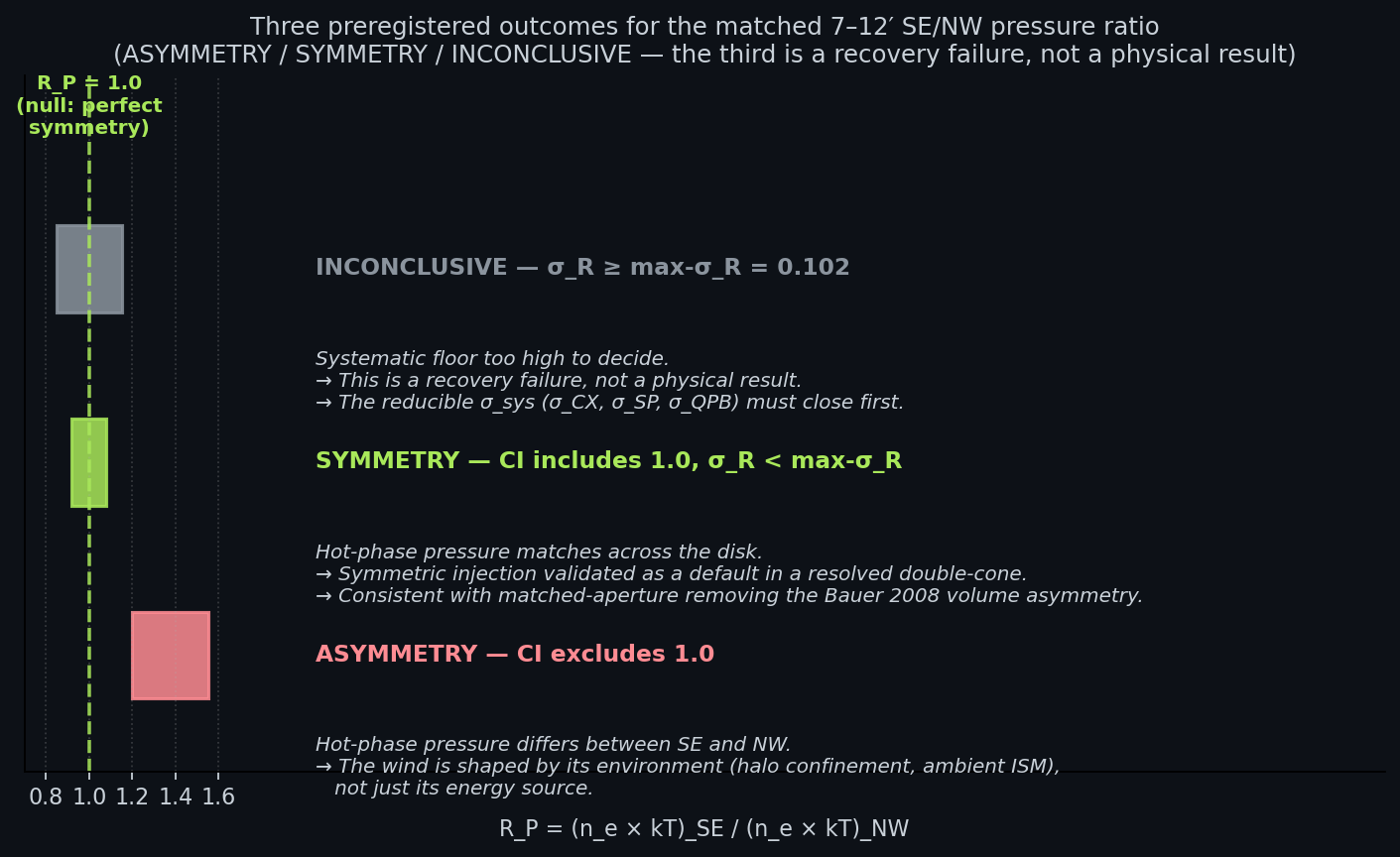
The number we would report is a 95% confidence interval on log10(RP). The threshold is aperture-independent: max-σR = Amin/k = 0.20/1.96 ≈ 0.102 (T3421). A symmetric outcome requires σR < 0.102; an asymmetric outcome requires the CI to exclude 1.0; the third branch is the recovery failure
What it looks like if the answer comes out the other way
If the result is INCONCLUSIVE — and the σCX floor is currently 2.45× above the threshold, so this is the most likely outcome today — the page is honest about that. The INCONCLUSIVE branch is a recovery failure, not a null result. It means the reducible σsys budget (σCX, σSP, σQPB, σSB) must close before the measurement is fundable. The σCX term alone — bounded at 25% by Zhang et al. (2014) at the M82 11.6 kpc Cap and 8–25% by Lopez et al. (2020) at ±2.5 kpc — exceeds the threshold by 2.24–2.74× without any extraction-derived product. No choice of aperture can rescue it; max-σR is aperture-independent
If the result is SYMMETRY, the symmetric-injection default is validated in a resolved double-cone, and Bauer's measured SE-softer contrast is consistent with the matched-aperture design removing the volume asymmetry — not proven to be a volume artifact, because equal projected area leaves the line-of-sight depth through a non-spherical halo unconstrained
If the result is ASYMMETRY, the symmetric-injection default is refuted; single-cone feedback estimates are systematically biased; and the metal/energy budget escaping to the IGM vs recycling differs per side
The honest answer is that the null is not boring — it is a recovery failure that points directly at the next measurement to make. The page is not asking for compute to discover nobody wanted the result; it is asking for compute to either close the systematic floor or measure the asymmetry. Both are real results
Geometry — what the new observation looks like on the sky
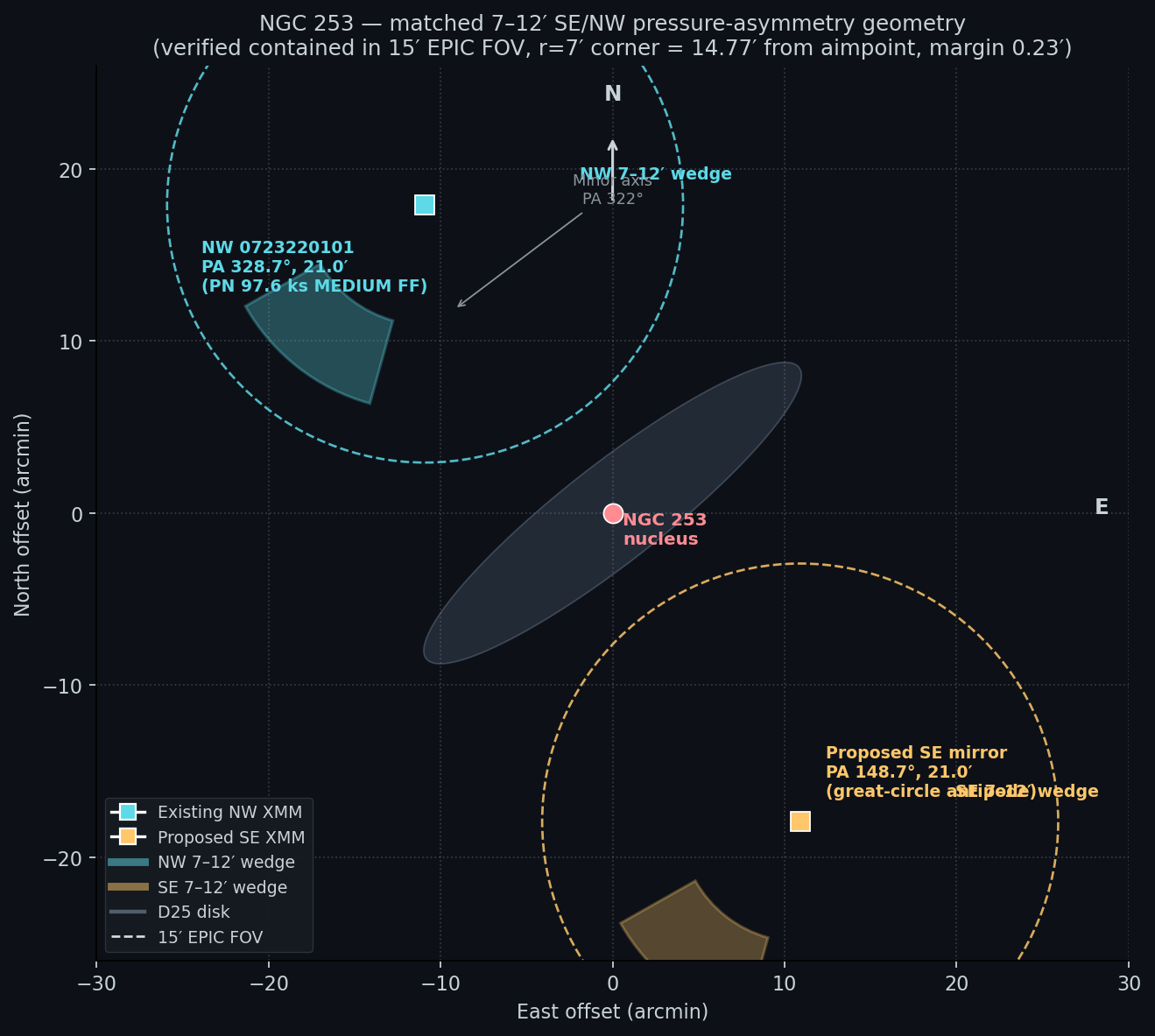
The geometry is the R2 execution of the I002-R4-01 REFRAME (cycle-obs1, R5/claude). The original 4–12′ aperture had a 17.36′ corner that fell outside the 15′ EPIC field radius; the refrozen 7–12′ aperture is fully contained. The fork also repairs the stale observational-shape coordinates (RA ≈ 12.0885° → 12.0895°, Dec ≈ −25.5871° → −25.5868° — the 3.36 arcsec tangent-plane vs great-circle antipode discrepancy, R4-C01 applied inline
Matched-sector area: 37.306 arcmin² per arm (0.742× the original 4–12′ area of 50.265 arcmin²). At 3.5 Mpc, the projected radial range is ~7–12 kpc
Why existing observations cannot answer it
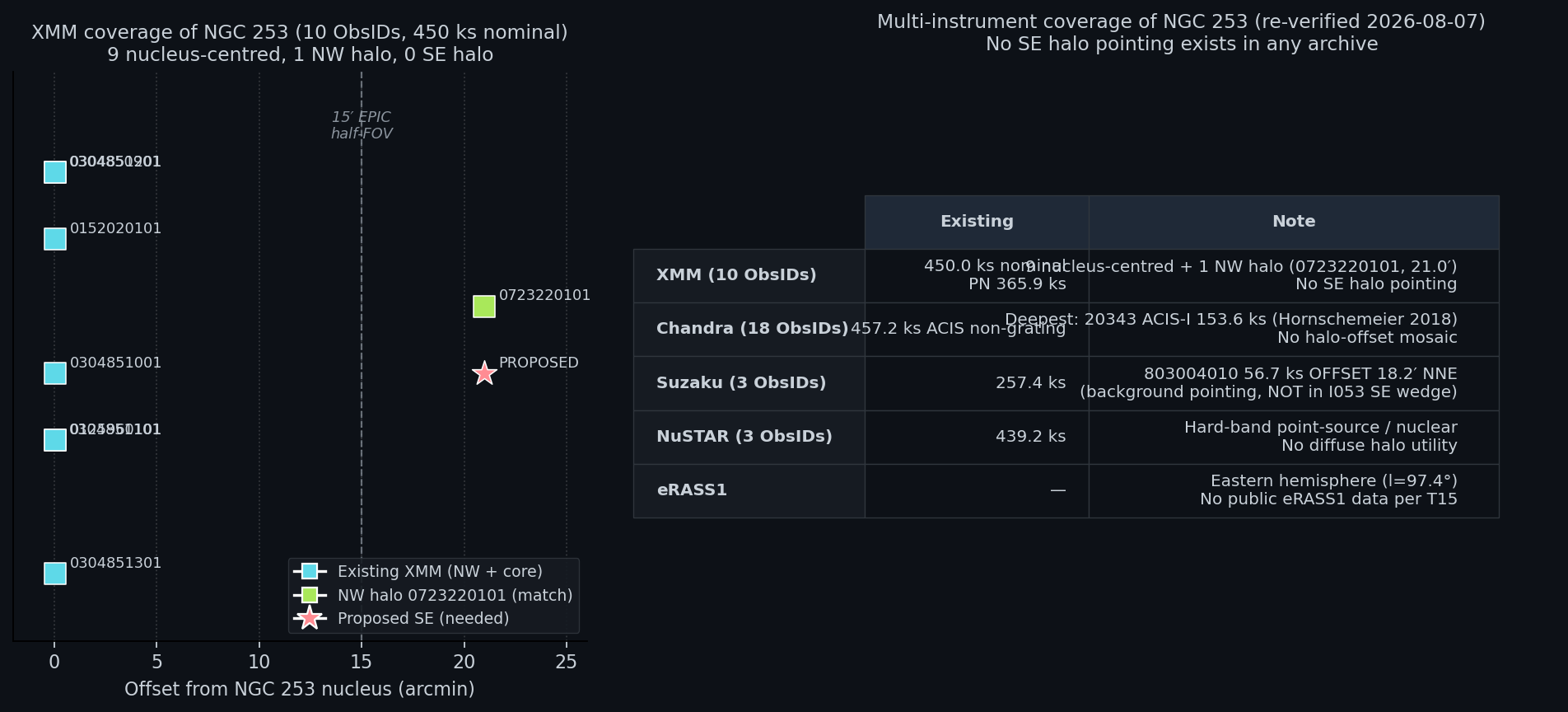
NGC 253 has a dedicated NW halo pointing (0723220101, 97.6 ks PN MEDIUM Full Frame, 2013; offset 21.0′ NW at PA 328.7° from nucleus) but no SE halo counterpart. All other XMM pointings cover only the nucleus (0152020101, 0304850901–0304851301). The SE halo is the natural symmetry counterpart and cannot be observed from the existing archive. Without a SE pointing, the two-sided comparison is impossible
eROSITA does not cover NGC 253 (eastern hemisphere, l = 97.4° — T11, T15). Chandra has no halo-offset mosaic for NGC 253 (unlike M82's Strickland mosaic); the deepest Chandra observation (ObsID 20343, 153.6 ks ACIS-I, Hornschemeier 2018) covers the central galaxy but its 16.9′ FOV misses the extended halo. Suzaku 803004010 (56.7 ks OFFSET) is at 18.2′ NNE of the nucleus — a background pointing, not a SE halo pointing
The new EPIC SE offset is required. Exposure is intentionally unsized in this proposal and must be derived by R6 from a response-folded recovery calculation — that calculation is the load-bearing deliverable (I002-E27) and is currently HEAVY-blocked
What it costs — and what is still unknown about the cost
What we know: the geometry is executable (7–12′ wedge contained in 15′ EPIC field, verified to 4 decimals). The matched-aperture design eliminates the Bauer 2008 volume asymmetry. The threshold side of the gate is aperture-independent (max-σR = 0.102, derived from design parameters Amin = 0.20 and k = 1.96, not from any measured quantity). The blocking item is the σCX systematic floor — bounded at 25% by Zhang et al. (2014) at the M82 11.6 kpc Cap and 8–25% by Lopez et al. (2020) at ±2.5 kpc — which exceeds the aperture-independent threshold by 2.24–2.74×
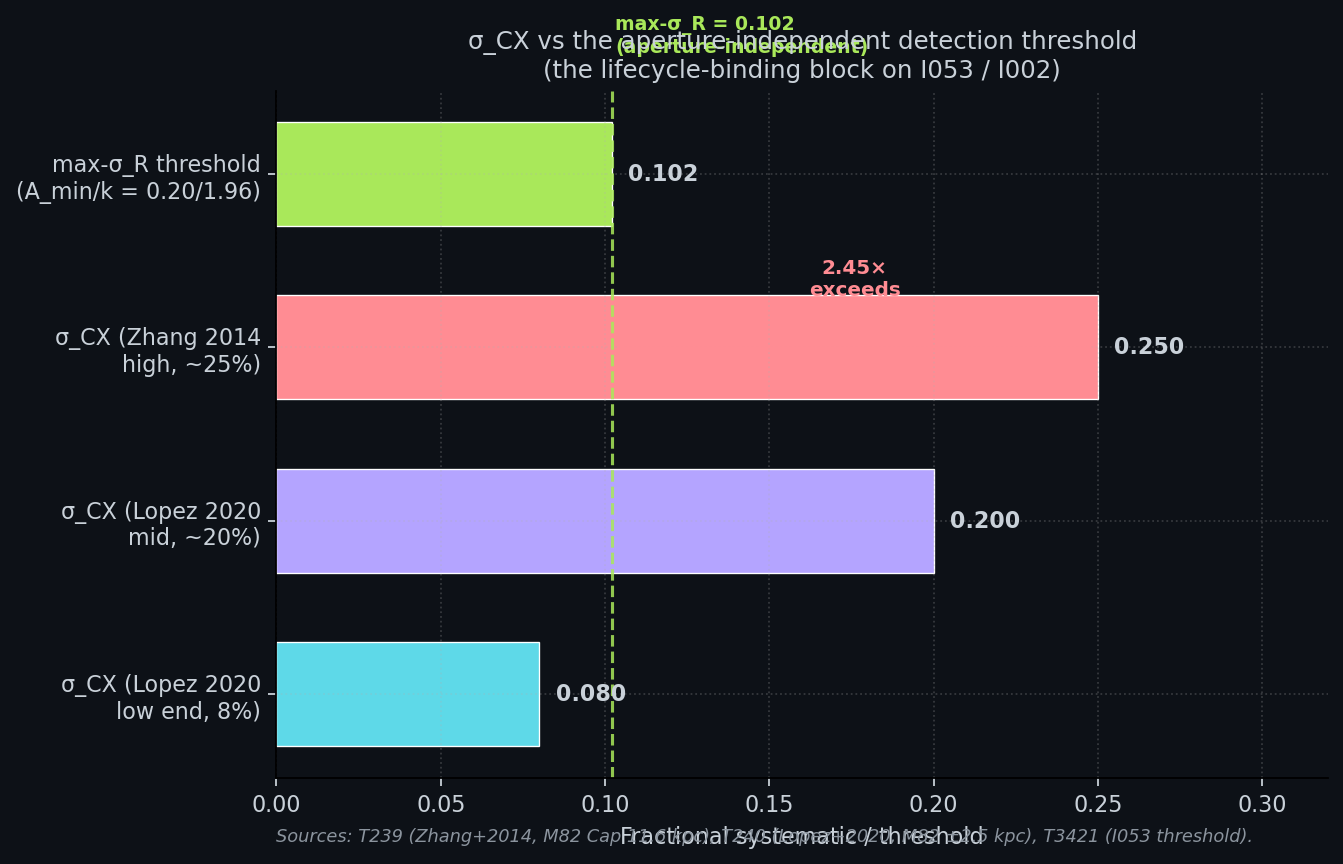
What we do not know: the exposure required for the SE pointing. R6 must derive it from a response-folded recovery calculation (per-camera ARF/RMF, ESAS QPB+SP+CXB background, source model grid, screening loss, effective area, preregistered pressure-ratio threshold with recovery curve and coverage). That calculation is blocked by the σCX floor: until σCX is reduced below 0.102, the recovery curve does not close, and any exposure number is unanchored
The reducible σsys budget has four terms: σCX (charge exchange), σSP (residual soft proton), σQPB (quasi-particle background), σSB (cross-calibration / epoch stability). Of these, σCX is the lifecycle-binding term; the other three are part of the I002-E22 / I002-E23 HEAVY deliverable
Gate ledger (D043 — single source of truth
| Gate | Status | Role |
|---|---|---|
| I002-E21 | NARROWED — APERTURE-INVALID (refreeze required | Bauer-2008-narrowed matched-sector pressure-asymmetry estimand + falsifiable detection threshold/systematic floor. HOLD, re-anchored cycle-obs1. Threshold side intact: max-σR (SE>NW = 0.1116, NW>SE = 0.0911) derives from Amin = 0.20 and k = 1.96 and is aperture-independent. Measured side voided: the frozen §10 geometry (rin = 4.0′, rout = 12.0′, θ = 22.5°, NW PA = −31.25°) is unrealizable in either camera field at the 20.99′ mirror/NW offset. σCX = 0.25 exceeds 0.1116 by 2.24× and 0.0911 by 2.74×, so no proposal-ready promotion can be supported |
| I002-E22 | OPEN | Epoch-dependent background and σsys error budget. Supporting input to I002-E21, not a substitute blocker |
| I002-E23 | OPEN | 0723220101 NW-halo matched-sector baseline extraction. HEAVY dependency of I002-E21; queued as FRONTIER_QUEUE Item 3 |
| I002-E24 | CLOSED — RESOLVED-NEGATIVE | Suzaku 803004010 overlap with the proposed SE sector. Non-blocking provenance/geometry result |
| I002-E25 | NARROWED | Halo-scale CX and absorption/neutral-gas nuisance bounds. Supporting input to I002-E21, not a substitute blocker |
| I002-E26 | OPEN | Bauer 2008 original-PDF transport verification. Non-blocking provenance gate |
| I002-E27 | OPEN | Matched-sector aperture refreeze: 7–12′ (rin ≥ 6.727′) 45° full wedge, BOTH arms, plus a reproducible response-folded count-rate product. Mandatory correctness repair — the idea's stated observational shape was unrealizable until it closes. NOT the blocking item (D041): closing it changes no lifecycle state while I002-E21/σCX blocks, so it is overhead-capped. This fork IS the R2 execution of E27: the aperture is refrozen at 7–12′ on both arms (geometry verified above), and the response-folded count-rate product is the next HEAVY deliverable |
What I am and am not claiming
I am claiming the science question is real (symmetric CGM energy/metal injection is a load-bearing belief in subgrid-feedback recipes); the geometry is executable (7–12′ wedge contained in 15′ EPIC field); the matched-aperture design eliminates the Bauer 2008 volume asymmetry; and the σCX systematic floor is the lifecycle-binding term that must close before the measurement is fundable
I am not claiming that a symmetric I053 result would prove Bauer's soft difference was a volume artifact — equal-area geometry removes one volume asymmetry but cannot by itself establish the counterfactual cause of Bauer's measured spectral contrast. The symmetric outcome is consistent with the artifact hypothesis, not a proof of it (R4-C02 applied inline). I am also not claiming that the SE pointing is feasible at any specific exposure — that requires the response-folded recovery calculation (I002-E27), which is HEAVY-blocked today
Provenance
- Idea file:
shared/ideas/I053_ngc253-se-nw-matched-pressure-asymmetry-7-12-fork.md - R3 Analyst evidence:
cycles/cycle-obs9/evidence/idea-I053.md - R4 Red-team (commit
a264137, gate=PASS):cycles/cycle-obs9/rebuttals.md(I053 Rebuttal Ledger);cycles/cycle-obs9/r4_i053_anchor_checks.py(SHA-256a4a98f44ad75cdb8a77a6e7dd28feb02534c9f70bbd62de22ab591fb819759d2 - R5-Portfolio adjudication:
cycles/cycle-obs9/r5_adjudication_i053.md(cycle-obs9, hermes, 2026-08-07 - Trust table rows: T09 (NGC 253 XMM ObsIDs), T11 (eRASS1 coverage), T34–T37 (NGC 253 nuclear/wind/halo science), T68 (Bolatto CO S/N), T73/T156 (Bauer SE/NW comparison), T210–T219 (I002-E21 floor inputs), T239–T242 (CX literature), T3266 (I053 archive refresh), T3420–T3425 (I053 fork-specific facts
- Shared sources:
shared/sources/I002_bauer2008_se_nw_halo_intake.md;shared/sources/I002_E25_cx_literature.md